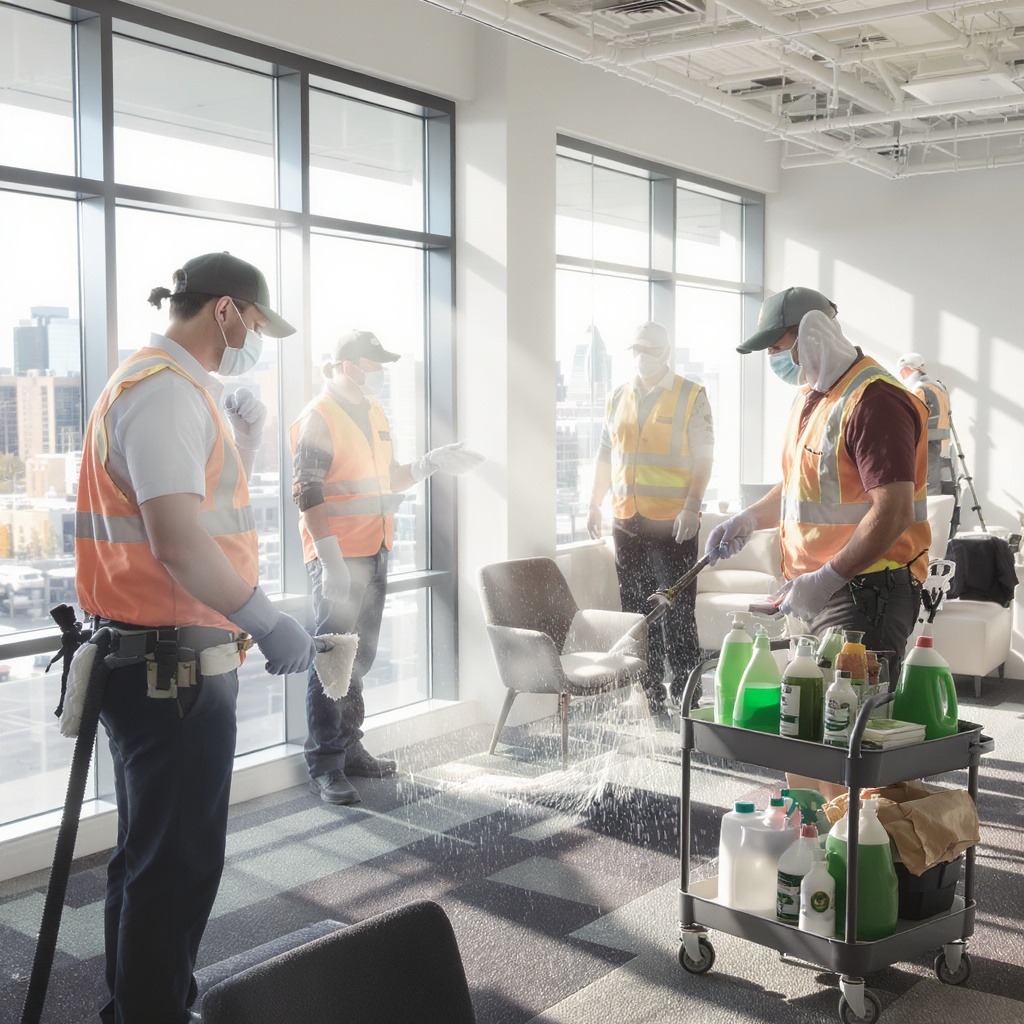
The property manager at Glenarm Place had a problem she couldn’t solve by switching vendors — she’d already done that twice. The real issue was in the cleaning protocol itself.
The building is a Class A office property in Downtown Denver, 28,000 square feet across six floors, with a mix of small-suite tenants and one anchor tenant occupying 40% of the rentable area. The anchor tenant was a financial services firm with 120 employees. In the 90 days before we were brought in, that firm had submitted four formal written complaints about cleaning quality to the property manager. Two had escalated to the landlord. The firm’s lease renewal was in six months.
They were serious about leaving.
What the Previous Vendors Got Wrong
The two prior cleaning vendors had both operated on a standard commercial model: same scope, same crew, same checklist, every night. The problem wasn’t effort — the crews were showing up and doing the work. The problem was scope definition.
Standard commercial cleaning covers the basics: trash removal, restroom service, floor care, surface wiping. What it doesn’t cover — unless it’s explicitly scoped — is the cleaning that prevents complaints. Specifically:
- Breakroom deep-clean on a scheduled rotation: In a 120-person office, the breakroom accumulates grime, spills, and appliance buildup that a nightly trash-and-wipe doesn’t address. Microbial load in microwave interiors, refrigerator spillovers, and sink basins degrade over a two-week period.
- High-touch surface disinfection: Door handles, elevator buttons, conference room tables, and light switches get missed on standard cleans unless there’s a specific protocol for them. In a financial services environment, employees notice this.
- Air-quality surface care: Denver’s dry climate means dust accumulates on low-reach surfaces — desk edges, window sills, baseboard tops — faster than in humid markets. A standard clean leaves these areas visibly dusty within 48 hours.
- Restroom detail on a fixed schedule: Nightly restroom cleaning covers the essentials. What it doesn’t cover is the grout discoloration, fixture calcium buildup, and partition smudges that develop over time and create a maintenance deficit that compounds.
The anchor tenant’s complaints weren’t about whether the floors were being mopped. They were about the net effect of the space — how it felt and smelled when they arrived in the morning.
The Protocol Change
When Tribute took over, we made three structural changes to the cleaning protocol that previous vendors had never proposed:
1. Dedicated anchor-tenant floor focus
The financial services firm occupied floors 3 and 4 — 11,200 square feet of the 28,000 total. We assigned a dedicated crew to those floors with a modified checklist that included:
- Desk edge and surface wipe-down on all workstations (not just common areas)
- Conference room reset after every use — including table cleaning and chair alignment
- Breakroom detail clean on a 72-hour rotation (not a nightly full-service, but a scheduled deep-pass)
- Air-return and HVAC vent dusting on the 14-day rotation
2. Weekly high-touch disinfection protocol
We added a weekly high-touch surface disinfection service on Mondays — before the start of the business week when conference rooms are most heavily used. This covers:
- All door handles (entry, interior, and restroom)
- Light switches and electrical covers
- Conference room tables and chairs (full surface, not spot-clean)
- Reception area surfaces
- Elevator buttons and handrails
3. Monthly restroom detail restoration
Once a month, we run a restroom detail pass that covers what nightly service can’t: grout restoration cleaning, fixture calcium removal, partition deep-care, and exhaust fan cleaning. This keeps the restrooms at a level that prevents the cumulative degradation that makes facilities feel neglected over time.
The Results
Over the first 90 days of the new protocol:
- Formal tenant complaints: down 60% — from 4 formal complaints in 90 days to 1 in the first quarter post-transition (and that one was about a scheduling change, not cleaning quality)
- Anchor tenant lease renewal: executed — the financial services firm renewed for 18 months, retaining the $2.4M annual lease value that the landlord was at risk of losing
- Breakroom microbial measurements: ATP swab testing (LuminUltra protocol) showed a 73% reduction in surface ATP counts in the breakroom after 30 days of the new rotation
- Restroom satisfaction scores (anonymous tenant survey): improved from 3.1/5 to 4.4/5 over two quarters
The property manager’s comment in the tenant satisfaction survey: “For the first time in three years, I’m not dreading the lease renewal meeting.”
What This Means for Property Managers
The lesson here isn’t that the previous vendors were incompetent — it’s that “commercial cleaning” as a default scope is a floor, not a standard. The scope that works for a 5,000 sq ft professional office isn’t the scope that works for a Class A building with an anchor tenant that has 120 employees and a $2.4M lease.
What changes the outcome isn’t a different vendor — it’s a different protocol. Protocol is a property-level decision, not a vendor-level one. The property manager at Glenarm Place now has the framework to evaluate whether her cleaning vendor is delivering a protocol that matches the building’s actual needs — not just a checklist that checks the boxes.
Tribute Cleaning manages 76 commercial and residential buildings across Denver and Colorado Springs. We build cleaning protocols around your building’s actual load profile, not around a standard scope sheet.
Get a Protocol Review for Your Building
If you manage a Class A or B commercial property in Denver or Colorado Springs and want a protocol assessment, we’ll come out, inspect the space, and give you a written scope recommendation — no sales pitch.
Request a Protocol Assessment →See Our Published Rates →
Or call Esau directly: (720) 352-2020