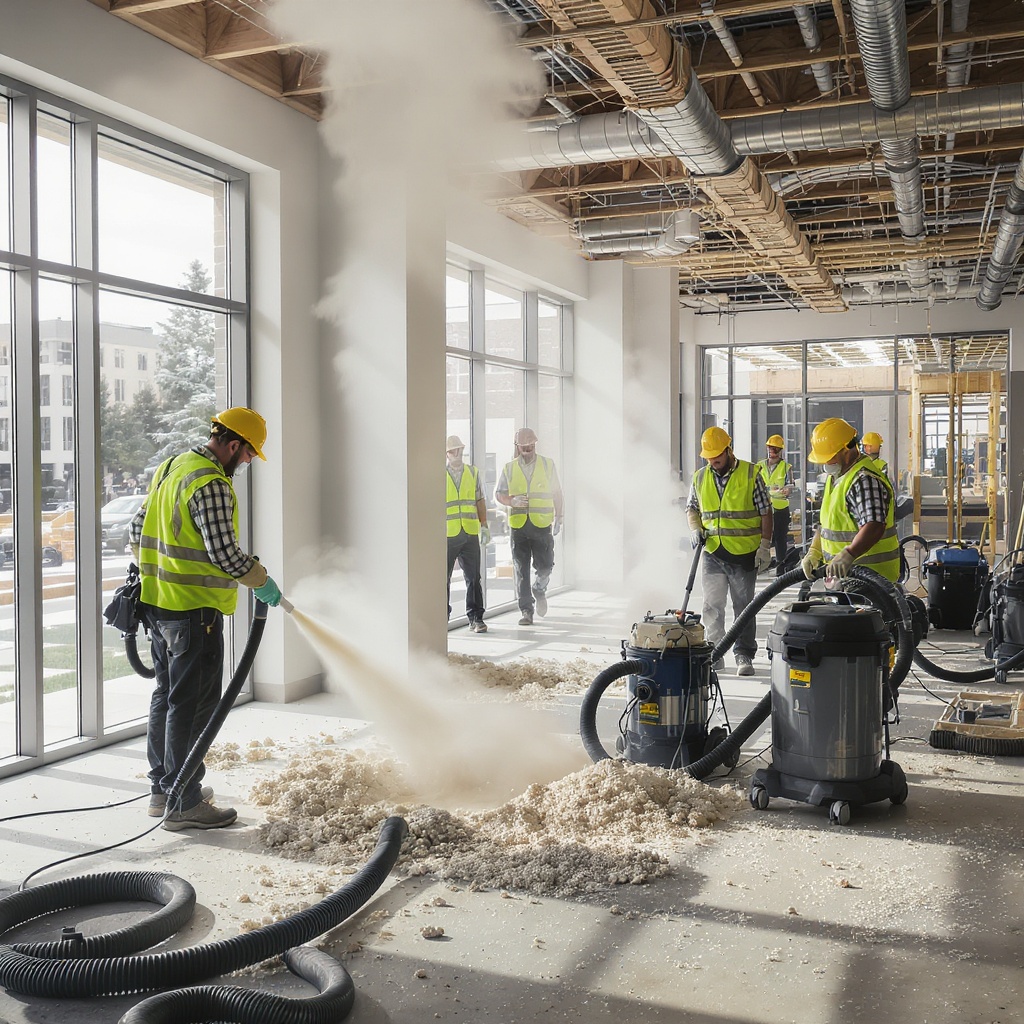
Most cleanup companies in Colorado don't publish pricing. They want you on the phone so they can read the room before they quote.
We publish ours.
Here's what construction cleanup actually costs in Denver and Colorado Springs in 2025 — broken down by phase, by square footage, and by building type. Use this as a reference before you sign anything with any vendor.
The Short Answer: Per-SqFt Ranges by Phase
Post-construction cleaning has three phases. Each has a different cost because each requires a different level of detail and labor.
| Phase | Denver | Colorado Springs | What's Included |
|---|---|---|---|
| Rough Clean | $0.10–$0.20 / sq ft | $0.08–$0.18 / sq ft | Debris removal, bulk dust sweep, site prep before finishes |
| Final Clean | $0.22–$0.45 / sq ft | $0.18–$0.40 / sq ft | All-surface wipe-down, glass, fixtures, floors — ready for occupancy |
| Touch-Up Clean | $0.10–$0.20 / sq ft | $0.08–$0.15 / sq ft | Post-punch-list pass — after furniture or IT install reintroduces dust |
| Full Package (all 3) | $0.40–$0.75 / sq ft | $0.30–$0.65 / sq ft | Complete rough-through-touch-up sequence |
Real Project Examples
- 12,000 sq ft Class A office — LoDo, Denver (final clean): $3,300–$5,400
- 4,500 sq ft medical TI — Briargate, Colorado Springs (full package, VOC-free): $2,250–$4,050
- 8,000 sq ft retail TI — Powers Corridor, COS (rough + final): $2,560–$4,000
Colorado Springs prices run 10–20% lower than Denver for equivalent scope — market-driven, not quality-driven.
What Drives the Price
Five factors determine whether your project lands at the low end or high end of those ranges:
1. Square Footage
The dominant variable. Larger projects have lower per-sqft rates because crew mobilization is amortized across more footage. A 30,000 sq ft build-out costs less per square foot than a 3,000 sq ft TI.
2. Debris Load
A GC that maintained a broom-clean site throughout construction costs less to clean than one that let drywall dust accumulate for three weeks. Debris load directly determines rough clean time.
3. Dust Mitigation Requirements
Medical office and tenant improvement builds in occupied or semi-occupied buildings require contained cleanup — negative air machines, dust barriers, off-hours scheduling. This adds cost but isn't optional in those contexts.
4. Ceiling Height and Access Complexity
Standard 9–10ft ceilings are baseline. Vaulted lobbies, exposed structural ceilings, mezzanines, and multi-story atriums require lifts, staging, and more time. Every foot of reach adds cost.
5. Schedule Pressure
Final clean under 72 hours from trade completion to occupancy requires surge crews — multiple teams working simultaneously. A 48-hour final clean on a compressed schedule can cost 30–50% more than the same scope with a standard 5–7 day window.
6. VOC Restrictions (Medical TI, Food Service, Childcare)
If your building requires VOC-free or low-VOC cleaning products — which medical facilities, daycares, and food service spaces increasingly do — you need a vendor who carries EPA Safer Choice-certified products as standard inventory, not as a specialty upcharge. Solvent-based industrial cleaners used the night before a same-day medical occupancy is a compliance failure waiting to happen.
Rough Clean vs. Final Clean vs. Touch-Up: What Each Actually Includes
This is where most GCs and property managers get surprised — because cleanup companies define these phases differently.
We define them this way, and we'll put it in writing before we start:
Rough Clean
When it happens: After major trades have finished, before finish carpentry and painting begin.
What's included:
- All construction debris: lumber scraps, cardboard, packaging material, scrap drywall
- Bulk dust knockdown on surfaces — air knife treatment on floors
- Initial sweep and removal of materials staged in the space
- Dumpster coordination and debris haul-out
What's NOT included:
- Detailed surface cleaning
- Window cleaning
- Fixture detailing
- Floor refinishing prep
Final Clean
When it happens: After all trades have completed and the space is mechanically complete (MEP commissioned, finishes installed).
What's included:
- All-surface wipe-down: walls, trim, baseboards, doors, door frames
- Window cleaning: interior glass, tracks, and sills — both sides
- Light fixtures and diffusers — dust removal
- Vents, grilles, and return air grilles — compressed air blow-out and wipe
- Kitchen and bathroom fixture polishing: stainless, chrome, glass
- All flooring: vacuum, mop, and machine scrub as appropriate for surface type
- Stairwells, handrails, elevator interiors
- Cabinet interiors and exteriors — construction film and dust removed
- Closet interiors and utility rooms
Touch-Up Clean
When it happens: After final clean but before tenant move-in. Triggered by: furniture installation, IT infrastructure setup, signage installation, punch-list correction work.
What's included:
- Fingerprint removal from glass and door surfaces
- Surface re-dusting after late-stage trade work
- Minor scuff marks on floors
- Final bathroom refresh
- Entryway glass re-clean
Touch-up is not optional after IT and furniture install — if a vendor quotes you "final clean" but plans to do it once before those trades, you're getting one clean, not the clean you need at handover.
Medical & Tenant Improvement Build-Outs: Why VOC-Free Matters
Briargate. DTC (Denver Tech Center). RiNo. These are the neighborhoods driving the highest-intent construction cleanup searches in this market — because they're full of medical offices, specialist clinics, and tenant improvements that need to be occupancy-ready the day after the GC walks off the job.
The Same-Day Occupancy Problem
Medical TI work in Briargate has a specific constraint that doesn't show up in standard construction cleanup pricing guides: same-day occupancy. Dental suites, pediatric clinics, and physical therapy offices can't afford a 48-hour vacancy between GC handover and patient appointments.
This means:
- Cleaning happens on the same day or night as the final trade
- Cleaning products must leave zero respiratory risk for patients arriving the next morning
- The cleaning must pass whatever air quality standards the building's certificate of occupancy requires
The Industrial Cleaner Problem
Most construction cleanup companies — including every Colorado Springs competitor we've researched — use industrial solvent-based products as their standard. These products off-gas. The space smells clean. It's not — it's saturated with VOCs that continue releasing for 24–72 hours after application.
For a medical tenant moving in the same day, this is a facility compliance issue, not a preference.
What VOC-Free Actually Changes
EPA Safer Choice-certified, plant-derived cleaning products have zero VOC off-gassing. The space is genuinely clean — not just visually clean. The air quality at handover is the same as it will be six months later.
For medical TI projects in Briargate, DTC, and RiNo, this is increasingly a contract requirement, not a marketing claim. If you're quoting a medical TI and your cleanup vendor is using conventional industrial products, the medical tenant's compliance officer will catch it.
Red Flags When Comparing Bids
Every cleanup bid looks like the same scope until you sign. Here's what separates a clean handover from a punch-list nightmare:
1. Vague Scope Language
"Complete professional cleaning of all surfaces" means nothing. A real scope specifies: walls, trim, baseboards, doors, door frames, windows (both sides), vents, fixtures, floors, cabinets (interior and exterior), bathrooms, and trash removal. If the bid doesn't list these items, it doesn't cover them.
2. No Debris Removal Line Item
Bulk construction debris removal is a separate cost from cleaning. Some vendors absorb it; others bill it separately. Either way, it needs to be explicit. A bid that doesn't mention debris removal means they're assuming the GC handled it — which often means it wasn't handled.
3. Missing Dumpster Fees
Large debris loads require a dumpster. If the bid doesn't mention it, either the vendor is assuming the GC provides one, or they're planning to use the building's existing waste stream — which causes problems at most commercial properties. Always clarify.
4. No COI (Certificate of Insurance)
Minimum requirement: $1M general liability, workers' comp. You should be listed as additional insured. A vendor who can't provide a current COI before signing isn't a vendor you want on your job site.
5. Solvent-Based Products on a Medical TI
If your project is a medical office, dental clinic, childcare facility, or food service space, and the vendor quotes cleaning with standard industrial products, they're quoting the wrong clean. VOC-free isn't optional at those facilities. It's a compliance requirement.
6. No Punch-List Sign-Off Process
A professional cleanup vendor should walk the completed clean with you before they leave. If the bid doesn't mention a punch-list walk-through or sign-off, you're relying on the vendor's word that the job is done — with no recourse if it's not.
What to Ask Before Signing
Before you commit to any construction cleanup vendor, get answers to these six questions in writing:
- What specific surfaces are included in your scope? (Walls? Inside cabinets? Behind appliances? HVAC grilles? Window tracks?)
- What cleaning products do you use, and do they meet our building's VOC requirements? (Get the product name and certification — "eco-friendly" is not a standard)
- What happens if punch-list work after your final clean requires a touch-up? (Free callback within 48 hours? Chargeable? Not included?)
- Who is on your crew, and do they have experience with this building type? (Medical TI requires different methods than retail)
- What documentation do you provide at job completion? (Photo log? Punch-list sign-off? Waste manifests for LEED projects?)
- Do you carry $1M general liability, and can you add us as additional insured? (COI must be current — within 30 days)
Want a template to send to vendors? Download our construction cleanup RFP template — it includes all six questions above plus a scope checklist that matches what professional cleanup actually requires.
Real Example: 12,000 Sq Ft Class A Office Final Clean — LoDo, Denver
A general contractor in LoDo called us three days before a 12,000 sq ft Class A office was scheduled for tenant handover. Previous vendor had cancelled. Punch list was due in 48 hours.
Scope:
- Final clean only — GC had handled rough clean
- 12,000 sq ft, 3rd floor, downtown Denver high-rise
- Multiple conference rooms, open-plan workspace, kitchen/break room, 6 bathrooms
- Glass from floor-to-ceiling lobby to 10th floor — interior and exterior panes
Our approach:
- Two crews, 16 combined crew-hours over two evenings
- HEPA-filtered vacuum on all HVAC returns before final clean
- VOC-free products throughout — same-day occupancy confirmed by tenant's compliance officer
- Photo log of all key surfaces before and after
Result: Punch list cleared in two passes. Tenant occupied the following Monday. No callback visits required.
Final clean cost: $3,960 ($0.33/sq ft, within Denver market range for a full final clean on a Class A space)
Read more project results on our case studies page.
Get an Accurate Price for Your Project
Every project is different. Square footage is a starting point — not the whole number. Tell us your project address, square footage, phase(s) required, and target occupancy date. We'll respond with a scoped flat price within 1 business day.
Get a Project Quote →Get an Instant Price Estimate →
See our published recurring pricing for ongoing janitorial needs after occupancy. Or book a cleanup online with instant deposit.